
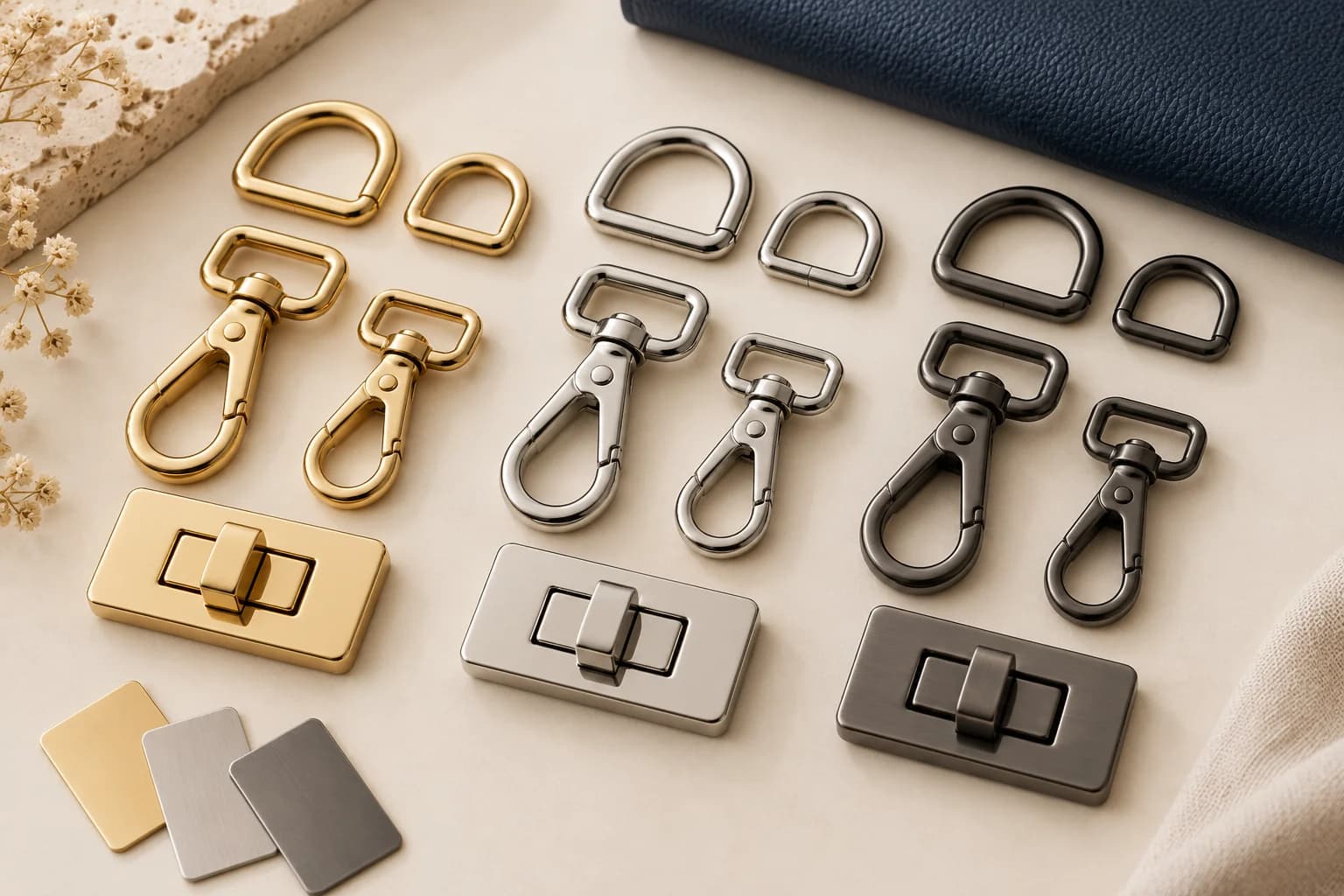
A gold turn lock, gold ring and gold snap hook can look unrelated when placed on the same bag. The catalog color name is only a starting point: buyers also need agreement on brightness, surface texture and how the components look together.
For brands developing a coordinated collection, finish matching is best treated as a sample-approval task. This workflow turns a general request such as light gold into a clear physical reference and a coordinated sample set.
01 / SPECIFICATION
Separate the base material from the finish
The base material describes the component underneath its surface treatment. The finish describes its surface appearance or process. A silver-colored fitting is not automatically stainless steel, and an antique brass color does not establish a solid-brass body. Keep these fields separate on your request and purchase order.
Also distinguish appearance from process. Matte describes a visual surface character, not a unique coating method. Anodizing, for example, forms an oxide finish on the underlying metal; it is not simply another name for silver paint. Confirm the actual process for each selected item rather than inferring it from photographs.
| Field | What to record | Avoid relying on |
|---|---|---|
| Base material | Confirmed material for each component | The visible color as proof of metal type |
| Color direction | Approved reference ID and descriptive name | Gold or black alone |
| Gloss | Approved polished, satin or matte appearance | A bright product photograph |
| Texture | Smooth, brushed or other agreed surface character | Color name as a texture specification |
| Process | Confirmed treatment where relevant | Assuming all matching parts use one process |
Further reading: Aluminum Anodizers Council — What is anodizing?
02 / COLOR REFERENCE
Use a physical master, not a phone screen
Send a representative physical hardware sample when close matching matters. Give it a reference number and record which face represents the target. Include photographs for identification, but do not let an edited image become the only approval standard.
Pantone's guidance emphasizes physical references when moving from digital color selection to physical products. For metal hardware, use that principle carefully: a printed or textile color reference can communicate direction, but it is not automatically a validated metal-finish match.
If no physical master exists, request a small set of finish options on the intended components. Select and label one after review, and keep corresponding samples with the buyer and supplier. Record the approval date so an older sample is not confused with a revised color.
Further reading: Pantone — Why physical color reference samples matter
03 / APPEARANCE
Compare hue, gloss and texture together
Konica Minolta explains that surfaces can appear to match under one light source and differ under another, a phenomenon called metamerism. It also notes that gloss affects perceived appearance. Those are reasons to control how a finish comparison is made instead of judging two photographs taken in different rooms.
Place clean samples side by side against the same neutral background. Agree the viewing conditions and inspect in the lighting relevant to the collection, such as the intended store environment as well as a controlled reference condition. Tilt the samples to compare their visible faces, rather than judging only the strongest reflection.
Compare like areas wherever possible. The broad face of a turn lock and the curved wire of a ring reflect their surroundings differently. Review the components both loose and installed on the bag, and record whether any contrast is intentional.
Further reading: Konica Minolta — Common color issues
04 / COORDINATION
Approve the complete hardware set
Build a component list for each bag style: closure, rings, hooks, sliders, feet, chain and logo hardware where applicable. Include quantities per bag and identify the visible faces. A finish can be acceptable in isolation but unsuitable beside the focal closure.
Request a coordinated sample set instead of approving one hook and assuming the rest will match. If components require different base materials or finishing routes, ask the supplier to review feasibility before promising a tight match to your customer. Do not substitute a different treatment after approval without reviewing the new set.
Keep the selected leather or fabric beside the hardware during final design review. This is not a substitute for a controlled color comparison, but it helps confirm the overall look you actually intend to sell.
- List every component reference and its quantity per bag.
- Identify the master finish sample and approved set version.
- Record whether polished, satin and matte components may be mixed.
- Flag any component still awaiting a physical matching sample.
05 / ACCEPTANCE
Turn looks good into an approval record
Agree how acceptable variation will be judged before the bulk order. Depending on the project, this may involve a signed physical master, boundary samples, a defined visual review or appropriate instrumental measurements. Do not impose a color-difference number without agreeing the measurement method and whether it suits small or curved parts.
Separate appearance requirements from durability requirements. If corrosion, abrasion or coating adhesion matters, specify the relevant method, exposure or operating conditions and pass criteria with the supplier. A generic promise such as salt-spray tested does not state what was tested or what counted as a pass.
ASTM's B117 scope cautions against using salt-spray results alone to predict natural-environment performance. Treat a test report as evidence for its stated conditions and specimens, not a conversion into years of use or a blanket claim for all finishes.
Further reading: ASTM International — B117-26 public significance and use
06 / REORDERING
Make repeat orders traceable
Reference the approved sample ID, component list and finish description on subsequent orders. Store master samples so they remain identifiable and protected from handling damage. Record changes rather than silently replacing a reference that has become scratched or altered.
Ask how incoming components will be compared with the agreed reference and how nonconforming pieces will be handled. Recheck the coordinated set when adding a new component, changing material or approving a different finishing route. A new product should not inherit finish approval only because its color field uses the same wording.
TIANHUI PRODUCT REFERENCES
Start with real product specifications
Use these current Tianhui listings to make your brief specific. Select a model, compare its listed dimensions and options, then tell us what your project needs.

One aluminum body, different named finish processes
- Body Material
- Aluminum
- Finishes
- Anodized Silver / Anodized Black / E-coat Black
- Inner Width Options
- 20 mm / 25 mm / 32 mm / 38 mm
Anodized Black and E-coat Black are separate options in this listing; sharing a black color name does not make the processes interchangeable. Its supplied photos are silver-tone construction references, so approve the selected black finish with a physical sample rather than inferring it from the gallery.
View product specifications
Anodized black and silver on a curved aluminum loop
- Material
- Aluminum
- Finishes
- Anodized Black / Anodized Silver
- Product Type
- Curved single-slot strap loop
The anodized finish options are identified for this product. Compare a sample of the actual curved part with the other components; a shared process or color label alone does not guarantee a visual match across a hardware set.
View product specifications
Matte black and silver appearance options
- Material
- Aluminum
- Finishes Shown
- Matte Black / Matte Silver
- Product Type
- Two-slot tri glide buckle / webbing strap adjuster
Matte Black and Matte Silver describe the supplied surface appearance. Use these names for your visual reference, and confirm the finish process separately if your purchasing specification requires one.
View product specificationsCOMMON BUYER QUESTIONS
Frequently asked questions
Why do two gold hardware items look different?
Gold is a broad appearance label. Hue, brightness, texture, process and component geometry can differ. Compare physical samples as a coordinated set before approving the finish.
Can a Pantone number guarantee an exact metal finish?
No. It can help communicate a color direction, but the reference material and metallic surface effect differ. Confirm feasibility and approve a physical hardware sample using agreed conditions.
Does matte silver mean anodized aluminum?
No. Matte silver describes appearance and does not identify the base material or finishing process. Ask for both separately; do not infer them from color or texture.
Should all components use the same finish process?
Not necessarily. Different materials or constructions may need different routes. The coordinated appearance and any performance requirements must be evaluated on the actual components.
What should I send for a matched hardware quotation?
Send the component list, quantities, preferred physical color reference, gloss and texture requirements, intended application and delivery destination. Note any agreed test requirements separately.
References & further reading
- Aluminum Anodizers Council — What is anodizing?
Industry association explanation of anodizing as an electrochemical oxide-forming process, not proof of any Tianhui product specification.
- Pantone — Why physical color reference samples matter
Supports the distinction between digital color selection and physical product approval; it does not certify a metal-finish match.
- Konica Minolta — Common color issues
Measurement manufacturer explanation of light-source differences, metamerism and the effects of gloss on appearance.
- ASTM International — B117-26 public significance and use
Public scope explains limits of standalone salt-spray results; no Tianhui test or performance claim is implied.