
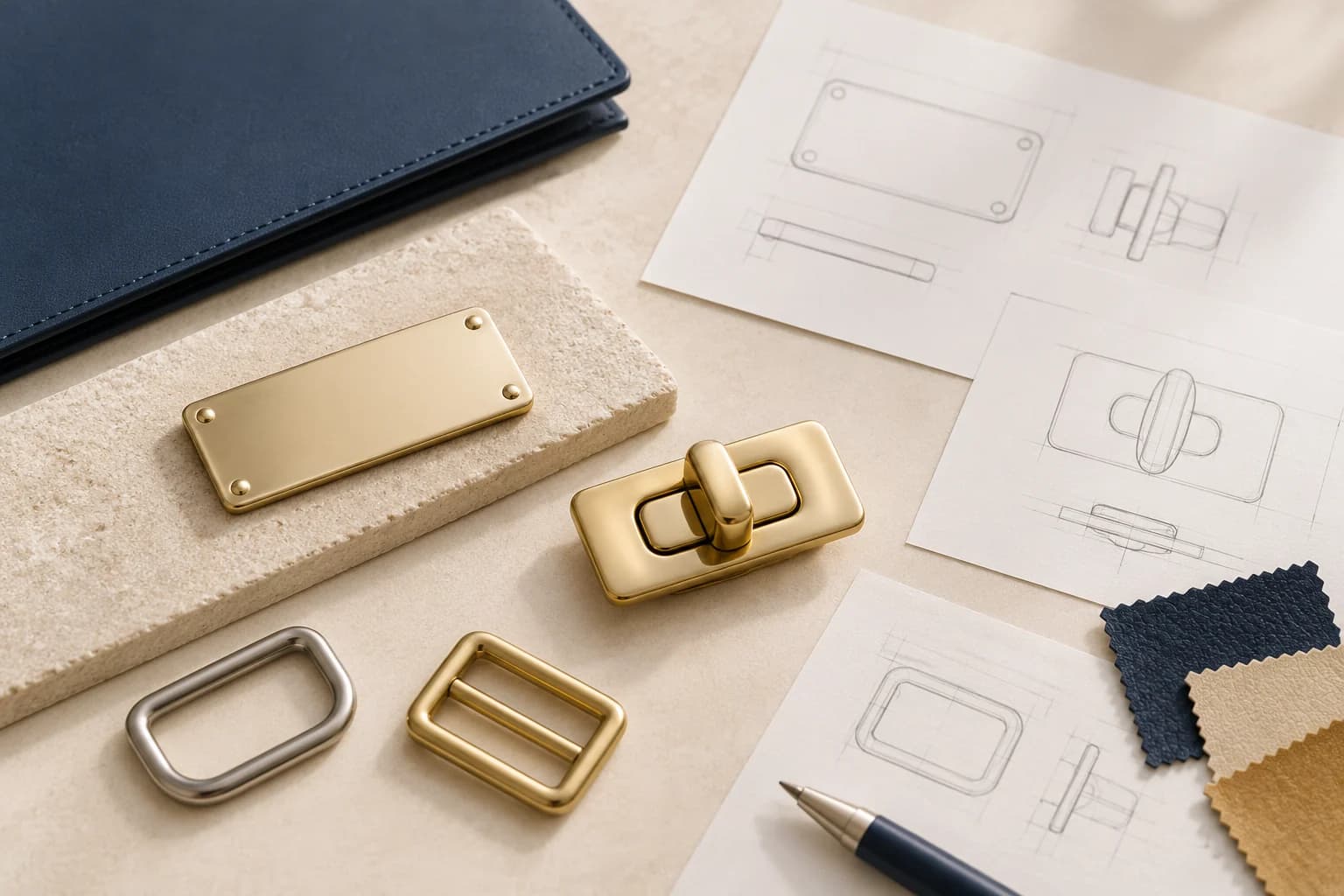
A custom logo plate and a completely new handbag lock may both be called custom hardware, but they are not the same buying task. Treating them as one can leave a quotation missing the tooling, attachment parts or finish development that the project needs.
This guide is for brands, bag manufacturers and sourcing teams preparing a development brief. Use the steps below to make suppliers quote the same specification, compare the total project cost and decide what must be approved before production.
01 / Define the change
Decide whether you need a modification or a new component
Begin with the closest existing item and mark what must change. A different appearance may be possible without changing the body shape; a new strap opening or mounting arrangement may require a different route. Ask the supplier to identify which features can remain and which need new development.
A reference image communicates style, not a complete specification. Add a drawing or annotated photograph showing the opening, outer dimensions, thickness, attachment and visible faces. For moving hardware, explain how the customer will open, close and connect it.
| Your change | What to clarify first | What the quotation should distinguish |
|---|---|---|
| Logo on an existing item | Artwork, location, size and how the mark is applied | Artwork or marking setup versus any change to the body |
| A different finish | Physical color reference, gloss, texture and visible surfaces | Finish development, batch requirements and sample scope |
| A different size or mounting | Critical dimensions, mating parts and assembly method | New or modified tooling and any fitting operations |
| A new shape or mechanism | Function, material, drawing revision and approval stages | Development, tooling, assembly components and production price |
02 / Clarify quantities
Ask what the MOQ applies to
MOQ means minimum order quantity, but a number without a scope is not enough. Ask whether it applies to each design, each size, each finish or the combined order. Do not assume several colors can be pooled into one minimum. Existing stock and made-to-order production may also have different conditions.
Share the first purchase quantity separately from your estimated repeat demand. A forecast helps a supplier assess options, but it is not a purchase commitment. If the first run is small, ask about an existing body, fewer finishes or a staged sample-and-production plan rather than requesting an unsupported universal minimum.
- List the required quantity for every size-and-finish combination.
- Clarify whether left/right pieces or several components make one set.
- Confirm sample quantity, sample charges and freight separately.
- Ask whether repeat-order minimums differ, and record the answer in the quotation.
03 / Compare the whole project
Separate tooling, development and the unit price
For die-cast parts, a tool is a manufacturing asset rather than simply a charge for adding a logo. NADCA identifies tool construction and operating conditions as contributors to die cost. The International Zinc Association also explains that complex parting lines and side-core requirements can increase tooling complexity. Ask for a design review before freezing details that are decorative rather than functional.
Compare quotations using the same quantity and finish, with one-time charges shown separately. Include required mating parts, finishing, packing and freight in the comparison. A low headline piece price is not directly comparable with a price that already includes those items. Confirm the trade terms and what the quoted total excludes.
If tooling is involved, agree who owns it, where it remains, how revisions are approved and what maintenance or replacement conditions apply. Do not assume paying a tooling invoice automatically grants exclusivity or transfer rights; record these terms explicitly.
| Line item | Information to request |
|---|---|
| Development and samples | What is included, number of revisions and delivery charges |
| Tooling or setup | Scope, ownership terms and charges for later changes |
| Production | Unit or set definition, quantity breaks, material and finish |
| Delivery | Packing, freight, trade terms and the event that starts the quoted lead time |
Further reading: NADCA Design — Tooling Costs · International Zinc Association — Tooling Implications
04 / Approve evidence
A visual sample is not the same as a production approval
Label the purpose of every sample. A shape model can help you review proportions, but it does not prove the final metal, coating, spring action or wear performance. Ask which production materials and processes a sample represents and which features remain provisional.
Fit the intended production sample to your actual leather, webbing, lining and reinforcement. Check screw or prong clearance, alignment, opening movement and contact with adjacent parts. Photograph the assembled result. An attractive loose fitting can still be unsuitable once installed on a folded or padded panel.
Approve appearance using a physical reference under agreed viewing conditions, not a screen image alone. For anodized aluminum, the Aluminum Anodizers Council notes that alloy, gloss and surface structure affect appearance and recommends agreeing an acceptable range. A color name by itself is not a complete finish specification.
- Identify the drawing revision and approved sample with matching references.
- Record critical fitting dimensions and how they will be checked.
- Retain an agreed finish reference and record acceptable cosmetic variation.
- Document required functional or compliance tests, methods and acceptance criteria before ordering.
- List open points separately; do not use an approval message that leaves them ambiguous.
Further reading: Aluminum Anodizers Council — Anodic Coating Specifications
05 / Make the handoff repeatable
Turn the approved sample into a purchasing specification
The final order should connect the approved drawing, material, finish reference, component list and quantity breakdown. Define packaging that protects the finish and keeps different sizes or colors identifiable. If you need inspection records or destination-specific documentation, agree the exact requirement rather than assuming a generic quality statement covers it.
Confirm the production schedule only after the supplier has the approved information. Ask what happens if artwork or dimensions change after tooling starts. For reorders, reference the same specification and disclose changes to your bag construction; a new leather thickness can affect fit even when the hardware drawing is unchanged.
06 / Get a useful response
Send a brief a supplier can actually quote
An effective request does not need a long presentation. Send a clear drawing or reference, the change you need, the size-and-finish quantities, your intended assembly and destination. State whether you want an existing option, a branded modification or a new design. Mark unknown details as questions rather than filling them with guesses.
Send Tianhui your logo artwork, drawing or reference sample, together with quantities by size and finish. We can review suitable options, sampling requirements and an itemized quotation.
TIANHUI PRODUCT REFERENCES
Start with real product specifications
Use these current Tianhui listings to make your brief specific. Select a model, compare its listed dimensions and options, then tell us what your project needs.

S932: define the customization request
- Product Code
- S932
- Lock Type
- 3-digit mechanical combination
- Finishes Shown
- Gunmetal and antique brass
- Customization
- Finish, logo and project details available on request
Start a customization brief with S932 as the reference model. Mark the finish, logo or construction changes you need, and include quantities by version so we can review the sample route and quotation.
View product specifications
Z-shape buckle: separate listed options from a new design
- Product Type
- Z-shape webbing connector buckle with dual spring gates
- Body Material
- Aluminum
- Inner Width Options
- 20 mm / 25 mm / 32 mm / 38 mm
- Finishes
- Anodized Silver / Anodized Black / E-coat Black
Listed size and finish options are existing catalog choices, not proof that a new geometry or mechanism can use the same production route. Specify exactly what would change before requesting a custom quotation.
View product specificationsCOMMON BUYER QUESTIONS
Frequently asked questions
Does all custom bag hardware need a new mold?
No. The route depends on what changes. A finish or marking request on an existing body may differ from changing the geometry or mechanism. Ask which tooling and setup operations your exact design requires.
What is the MOQ for custom bag hardware?
There is no universal minimum. Request the MOQ for each design, size and finish, and confirm whether sample, first-production and repeat-order quantities have different conditions. Tianhui terms must be quoted for the project.
Can I get a quotation without a CAD file?
A reference sample or annotated image can start a discussion. Include key dimensions, attachment details, quantity and the changes needed. A final production specification may still require a dimensioned drawing and feasibility review.
What should I approve before a bulk order?
Approve the drawing revision, representative production sample, actual assembly fit, finish reference and component list. Agree any required tests, packing, quantities and commercial terms, and identify unresolved points explicitly.
Does paying for tooling mean I own the design or receive exclusive supply?
Do not assume so. Tool ownership, intellectual property, exclusivity, storage and transfer are separate contract terms. Agree them in writing with the supplier before authorizing the work.
References & further reading
- NADCA Design — Tooling Costs
General die-casting tooling cost considerations; not a price list or a statement of Tianhui commercial terms.
- International Zinc Association — Tooling Implications
Design features affecting die complexity. Whether a specific bag fitting needs new tooling requires an individual review.
- Aluminum Anodizers Council — Anodic Coating Specifications
Finish appearance variables and the need to agree an acceptable range. Architectural coating specifications on that page are not asserted for Tianhui products.