
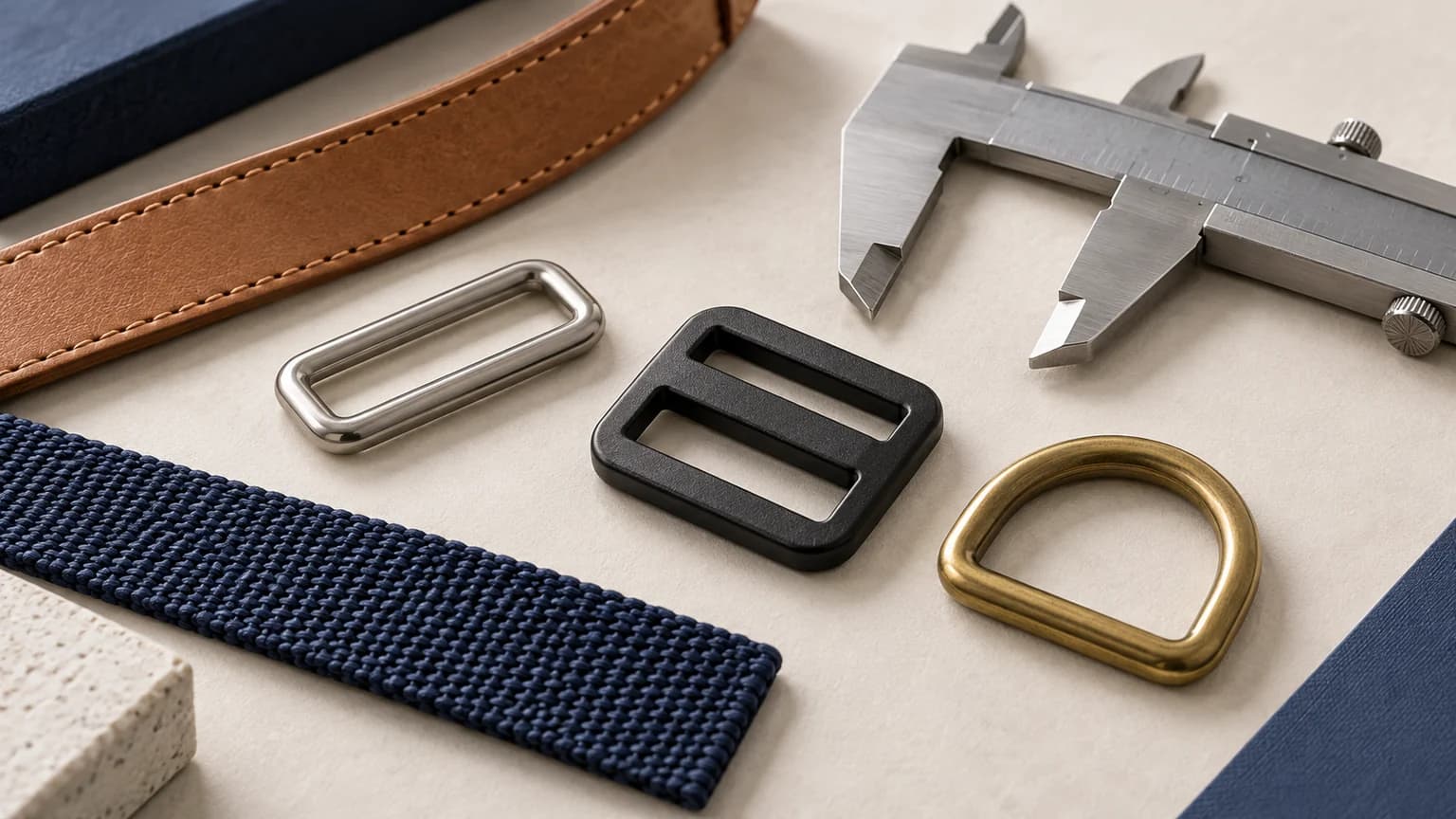
A buckle described as “20 mm” can look much larger than 20 mm across the outside. Two parts with the same nominal strap width can also have very different bodies, openings and functions. For a bag collection, that distinction matters: a part may look right on a mood board but pinch the strap, restrict a fold or fail to adjust as intended.
This guide separates the measurements that help you choose a sample. It does not replace a component drawing, an approved physical assembly or the testing needed for your finished product.
01 / READ THE DRAWING
The dimensions that matter
Check what the supplier means by “size.” Buckleguy, for example, explains in its measurement FAQ that its hardware sizes refer to internal dimensions. Do not assume every listing uses the same convention: identify the dimension on the actual product drawing.
| Measurement | What to check | Why it matters |
|---|---|---|
| Working inner width | The clear span through which the strap passes. | Starting point for matching the finished strap width. |
| Clear slot height | The usable opening at the intended passage. | The strap and relevant layers need to pass and move as intended. |
| Outside dimensions | The full length and width of the component. | Space on the bag, visual proportion and neighboring-part clearance. |
| Body or bar thickness | The metal section identified on the drawing. | Construction and contact geometry—not a strap-thickness allowance. |
Body thickness, clear slot height and strap thickness describe different things. Do not estimate a missing slot clearance from a product photograph or subtract the body thickness from an outside measurement.
02 / START WITH THE STRAP
Measure the finished strap, not just the raw material
Lay the strap flat without stretching it and measure across its finished width. Record the thickness and construction at the area that will contact or pass through the hardware. A raw strip does not tell the whole story once lining, folded edges, stitching or reinforcement have been added.
Prepare the actual strap end you plan to use. A folded leather return or a stitched webbing end can behave differently from one loose layer. Check the bend around the bar and the thickest area that must pass through the opening during assembly or adjustment.

There is no universal “add 1–2 mm” rule for every strap and fitting. A larger opening may introduce unwanted sideways movement without solving the relevant slot-height or bend issue. Share the material construction and confirm a sample instead of choosing an oversize part by habit.
03 / CHECK THE FUNCTION
Different hardware needs different fit checks

Tri glides and strap slides
A two-slot slide uses a threading path around its center bar. Check the width and clearance of both slots, then thread the intended strap as designed. Review adjustment and slippage behavior under the conditions agreed for the finished bag. A fit that feels snug by hand is not a verified slip-resistance or strength result. Start with our loops and strap adjusters to compare constructions.
Single-slot loops and D-rings
A closed loop or D-ring can be part of a fixed strap return rather than a length-adjusting mechanism. Check the internal width, the shape of the contact area and the finished fold around the frame. Allow for the intended direction of movement and the space taken up by the sewn assembly. See the available D-rings and O-rings rather than assuming a slide and a ring perform the same job.
Snap hooks paired with rings
The strap opening at a hook's base is not its gate opening. Review whether the gate clears the ring's cross-section, closes fully and permits the movement needed on the bag. Size names alone do not establish compatibility. Compare snap hooks and the mating ring together, not as isolated catalogue selections.
Pin buckles
Alongside the internal strap width, check the strap thickness, pin movement, hole location and the folded attachment. Outside size still matters for the bag or belt design, but does not replace those working dimensions. Use the selected buckle drawing and a finished strap sample to review the assembly.
04 / READ REAL PRODUCT DIMENSIONS
20 mm and 50 mm: three Tianhui examples
These examples show why nominal size and outside size must stay separate. Dimensions below come from the linked product specifications; the cards use the existing product photographs, not AI-generated SKU images.

20 mm two-slot tri glide
- Inner opening
- 20 mm
- Outside size
- 29.7 × 25.8 mm
- Metal body thickness
- 3 mm
An adjustable strap path with two slots and a center bar. Confirm the threading route and slippage behavior with your chosen strap.
View product dimensions
50 mm rectangular strap loop
- Inner opening
- 50 mm
- Outside size
- 60.9 × 16.5 mm
- Metal body thickness
- 3 mm
A closed, single-slot loop. Check how the finished strap end folds around the frame and clears the opening.
View product dimensions
20 mm curved single-slot loop
- Inner opening
- 20 mm
- Outside size
- 45.5 × 13 mm
- Metal body thickness
- 3 mm
A 20 mm internal slot within a longer curved body. Its 45.5 mm outside length is not a 45.5 mm webbing size.
View product dimensionsWhat is not confirmed: these three listings do not provide a clear slot-height specification, recommended strap-thickness range, load rating or slippage test result. The 3 mm metal thickness must not be used as a substitute for any of those values.
05 / BEFORE THE BULK ORDER
Approve a sample assembly, not just a loose metal part
Nominal sizing narrows the selection; it does not validate the whole strap system. Strapworks' FAQ also recommends trying the intended design before buying in quantity. For your project, make the review specific to the selected hardware, strap construction and use conditions.
- Confirm the actual inner opening, outside dimensions and slot clearance from the drawing or sample.
- Thread the intended finished strap, including any fold, lining, edge paint, stitching and reinforcement.
- Check adjustment, gate closure and freedom of movement in the intended direction of use.
- Inspect the strap and hardware contact surfaces for pinching, sharp contact or visible damage.
- Agree the relevant slippage, load, cycle and finish tests for the finished bag; do not infer a rating from a size label.
- Record the approved component, strap construction, finish and drawing revision before the bulk order.
06 / QUICK ANSWERS
Common bag hardware sizing questions
What size buckle should I choose for 20 mm webbing?
Start with hardware specified for a 20 mm strap or a 20 mm working opening. Then check the slot height, webbing thickness, edge construction and threading path. A nominal size alone does not confirm that a folded or reinforced strap end will fit and work correctly.
Is 1-inch hardware the same as 25 mm hardware?
One inch is exactly 25.4 mm, not 25 mm. A supplier may group nearby nominal sizes, but the actual opening and tolerances must be checked. Do not assume every 25 mm strap assembly fits every 1-inch part, or the reverse.
Does a 3 mm hardware thickness mean it accepts a 3 mm-thick strap?
No. Body thickness describes the metal part, while slot height describes the clear opening. Strap thickness is a third measurement. The three Tianhui examples in this guide list a 3 mm body thickness, not a maximum accepted strap thickness.
Can a snap hook and D-ring be matched by strap width alone?
No. Strap width may describe the hook's strap attachment opening rather than its gate. Check the gate opening against the ring's cross-section, then test full closure, movement and the intended orientation of the complete assembly.
Should I simply choose a larger slide for thick leather?
Not automatically. A wider opening can change sideways movement and the fit around the center bar without resolving the slot-height or bend requirement. Share the finished leather thickness and construction, and review a sample rather than applying a universal oversize rule.
References & product information
This guide combines supplier sizing conventions with the stated dimensions of our linked products. It does not claim that every supplier's nominal sizes are identical.
- Buckleguy — Frequently Asked Questions
Its measurement FAQ explains the use of internal dimensions. This is a supplier convention, not a promise that every supplier labels every dimension the same way.
- Strapworks — FAQs
Its sizing advice links hardware selection to webbing width and recommends testing the intended assembly before bulk purchasing.
- Tianhui — Product dimensions used in this guide
The linked Tianhui product pages supply the three dimensional examples below. Missing slot-height and performance data are not inferred from the photographs.